Gotramgasse: Energy center of the future (under construction): An energy center that pushes boundaries
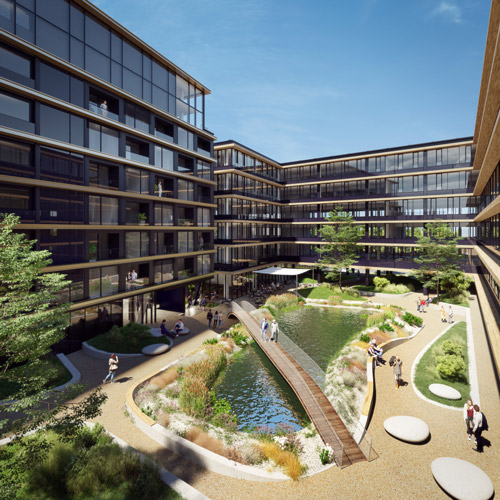
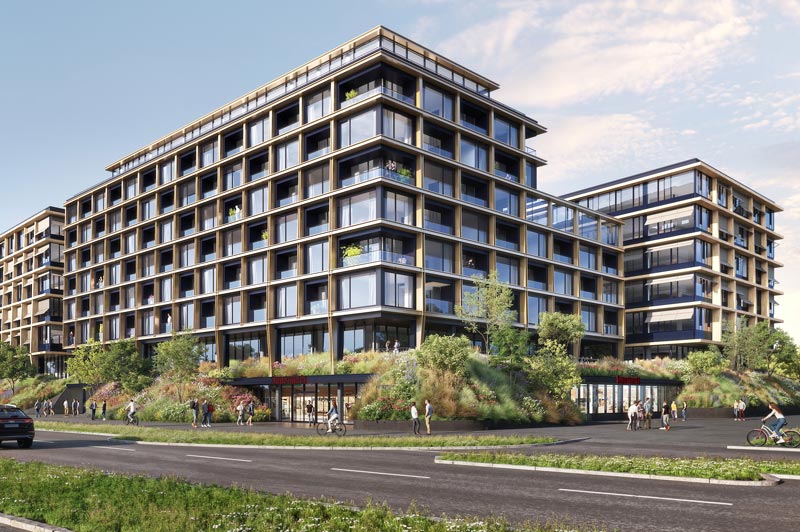
Large, mixed-use buildings place special demands on a fossil-free energy supply. In the S+B Group’s Gotramgasse project – a mixed-use building with over 33,000 m² of usable space – it became clear early on that a classic combination of geothermal probe field, heat pumps and photovoltaics would not meet the complex load profiles.
APESS GmbH was commissioned to fundamentally rethink, develop and design the energy center in such a way that it would guarantee stable, efficient and reliable long-term performance despite the most demanding conditions.
Challenge: A system that has to withstand real load profiles
The defined usage parameters changed significantly during the project phase.
Higher ventilation rates, more internal heat loads and heterogeneous requirements of individual tenants led to a shift in the energy balance – especially in the area of cooling and ventilation technology.
Simulations soon showed that the originally planned geothermal probe field would have been thermally overloaded in the long term. The result would have been falling source temperatures and low annual coefficients of performance – a system that would not have remained stable in operation.
However, more geothermal probes or additional drycoolers were ruled out due to the site conditions and funding conditions.
The APESS approach:
The ground as an actively controlled storage facility
APESS made a change of perspective: the ground was no longer regarded as a static source of energy, but as a dynamic seasonal energy store whose temperature is actively managed.
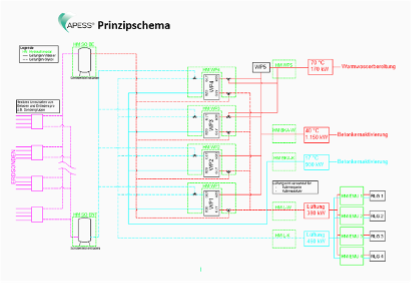
Excess heat from cooling, exhaust air flows and internal waste heat is specifically fed back into the ground, where it regenerates and thermally stabilizes it. In this way, the heating and cooling processes are interlinked via a balanced overall management system – an approach that is only possible with high-precision simulation and coordinated control technology.
The result is a system that requires neither additional probes nor recooling roof technologies in order to remain efficient in the long term.
Control intelligence as the key to a stable annual balance sheet:
The real innovation lies in the higher-level system control, which combines all components into an energy-managed overall system.
Probe temperatures, external climate, internal loads, air conditions and photovoltaic yields are permanently recorded and analyzed.
Operation is therefore not based on individual points of maximum efficiency, but on a year-round, stable overall design. This keeps the system within its optimum temperature window in all seasons – a decisive contribution to economic efficiency and service life.
The Gotramgasse project is an example of how the future of large-volume, fossil-free buildings does not lie in standard solutions, but in integrated, simulation-based energy systems.
With the energy center developed, APESS was able to realize a concept that not only reflects the challenges of the site and its use, but actively manages them – technically sophisticated, sustainably stable and energy-efficient in the long term.
Result: A model urban energy system
The Gotramgasse project is an example of how the future of large-volume, fossil-free buildings does not lie in standard solutions, but in integrated, simulation-based energy systems.
With the energy center developed, APESS was able to realize a concept that not only reflects the challenges of the site and its use, but actively manages them – technically sophisticated, sustainably stable and energy-efficient in the long term.