
Intelligent energy networking of kitchen ventilation systems
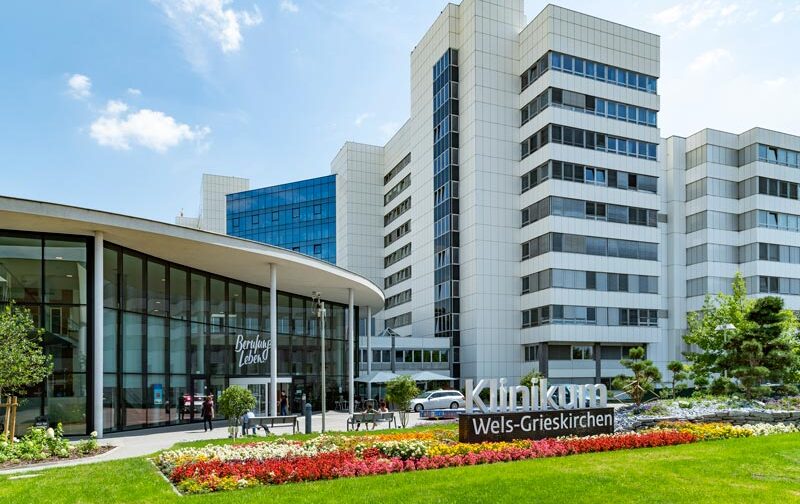
Clinic | Wels-Grieskirchen
A forward-looking approach to efficient building technology
As part of the comprehensive kitchen renovation at the Wels-Grieskirchen Clinic, a state-of-the-art energy center was implemented that intelligently networks five new ventilation systems.
The aim: to fully exploit the available energy potential of the various exhaust air flows and thus sustainably reduce the building’s heating energy requirements.
The result is a showcase project for modern building technology – efficient, intelligent and resource-saving.
Valuable energy in the exhaust air
The hospital’s new ventilation systems all work with heat recovery. In winter operation, the exhaust air is generally dry, as the supply air systems are not humidified. However, the exhaust air from the dishwashing system is a major exception: Due to high temperatures and increased humidity, it has a significantly higher enthalpy – i.e. a much greater energy content – than conventional exhaust air flows. Without systemic networking, this valuable energy would be lost unused. This is precisely where the innovative concept of the energy center comes in.OUR SOLUTION
A central energy center as an intelligent distributor
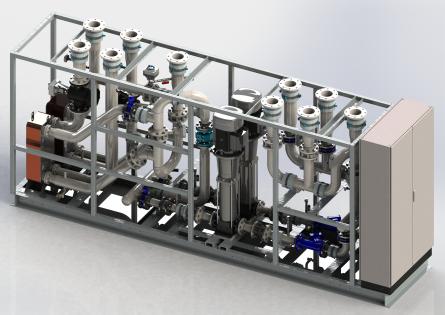
In order to utilize the energy potential of the sink exhaust air, a cross-plant circulation system was installed that connects the ventilation systems across several floors.
This central energy center collects the energy from the various exhaust air sources and distributes it as required to those areas that require heat supply – among others:
- warm kitchen
- Dining room
- Bakery
- Side rooms
This creates a dynamic, highly efficient energy system in which surplus heat is not lost, but flows directly to where it is actually needed.
Energy flow according to demand, not by chance
The exhaust air flows are hydraulically combined in the recirculation system. As a result, the particularly energy-rich sink exhaust air can systematically support the connected systems. Whilst the rinsing system itself has a slightly higher heating requirement due to the mixing of the exhaust air flows, the overall positive effect is significantly higher:
- Lower heating requirements in several kitchen areas
- More efficient use of high exhaust air enthalpies
- Demand-driven energy flow across several levels of the building
The system thus works as an intelligent energy distributor that relieves the building at those points where energy is actually needed.
The result: Up to 23 % more usable recovery energy
The energy assessment is based on a comparison of two scenarios:
Individual systems (without networking):
Annual heating requirement: 569,828 kWh/a (100 %)
Overall system (with central networking):
Annual heating requirement: 437,795 kWh/a (77 %)
This corresponds to a saving of around 132,000 kWh per year or a reduction in heating energy requirements of around 23%.
The systemic view is crucial here:
Without merging the ventilation systems into a common hydraulic unit and using the APESS Q Optimum control system, the total usable heat and cold recovery would have been around 23 % lower. The savings are made because the available energy is not limited locally, but is shifted between the systems and used optimally. In particular, the high energy of the purge exhaust air is thus made available to other areas
Classification of the results in real operation
The calculations are based on constant framework conditions and idealized assumptions.
In real operation, the actual savings may vary, as:
– Operating times and loads fluctuate
– The hydraulic efficiency under practical conditions is lower than in the theoretical mixed case
Nevertheless, the operation of the system confirms the calculations:
The added energy value of central networking is clearly recognizable and has a lasting effect.
Planning security and long-term savings
In addition to its technical sophistication, the project is also economically impressive.
Thanks to simulation-based planning, the future operating costs could be reliably estimated in advance. This creates a high level of investment security.
Centralized energy use leads to:
– permanently lower operating costs
– a clearly measurable contribution to sustainability
– high planning and investment security
– efficient building operation over the entire life cycle
Conclusion
The project impressively demonstrates that the greatest efficiency gain lies not only in the heat recovery of individual systems, but in the intelligent networking of the entire system.
The central pooling and needs-based distribution of energy turns several individual systems into a highly efficient overall system. In this way, energy potentials can be tapped that remain unused in unconventional systems – a clear step towards sustainable and future-oriented building technology.