
Modern energy architecture behind historic walls
HOTEL GOLDENER HIRSCH | Salzburg
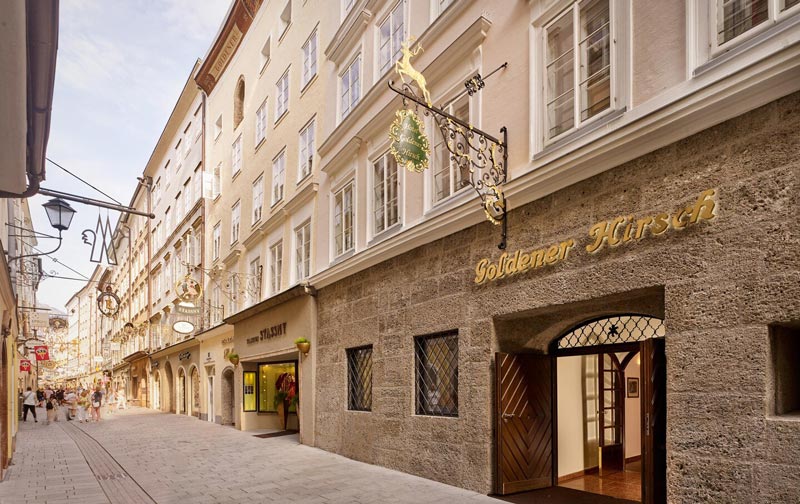
How sustainable building technology accompanies a traditional building into the future.
There are places whose history is immediately apparent – the Goldener Hirsch in Salzburg’s Getreidegasse is one of them. As a traditional establishment that has been a top address for the international festival society for centuries, it combines lived elegance with vibrant culture.
As part of the latest general refurbishment, APESS GmbH was once again commissioned to comprehensively modernize the building’s energy architecture and realign its energy efficiency. Previous optimizations during ongoing operations had already shown how sensitively and effectively technical interventions can be implemented in this historic environment. On this basis, APESS was commissioned to further develop the overall energy concept and integrate it into the existing structure – in a way that is compatible with the listed building, efficient and almost invisible during operation.
The mission: precision under the protection of history
The modernization of the energy center was carried out under the strict framework conditions of the UNESCO World Heritage Site and the requirements of monument protection. Every technical measure had to be carried out in such a way that the historical substance was protected, interventions were kept to a minimum and the characteristic appearance of the building remained untouched.
The challenge was to embed state-of-the-art building technology into the existing structure in such a way that it is barely noticeable in everyday life, but works with high precision in the background. Cable routing, device positions and static dependencies were precisely coordinated in order to create a system that respects the loads on the historic building components and ensures the building’s long-term energy stability.
The solution:
Technical precision in a historical setting
APESS implemented a compact energy and building technology solution that was fully integrated into the top floor and the designated technical areas. The system architecture links heat generation, ventilation and cooling to form an overall system that works harmoniously, quietly and largely invisibly during subsequent operation.
The central element is the APESS double exhaust air utilization system, which bundles different exhaust air flows and has been designed to safely dissipate high heat outputs. It processes exhaust air volumes of up to 12,000 m³/h and makes optimum use of thermal potential on a seasonal basis: In summer, excess heat is to be efficiently dissipated, while in winter the available waste heat can be used to heat the building. The heat recovery achieved during operation makes a significant contribution to the energy efficiency of the building and enables the seasonally balanced use of thermal potential.
Technical highlights
APESS double exhaust air utilization
The entire system is controlled by the APESS Q Optimum control system, which was optimized and put into operation as part of the contract. It coordinates the refrigeration process as well as the ventilation systems and ensures that the system remains stable, condensation-proof and acoustically inconspicuous even under changing conditions. This is complemented by a compact heat pump and a specially developed hydraulic unit in EMU design, which allows for particularly space-saving integration.
Another focus was on the control cabinet and control technology, which was individually designed and adapted to the special requirements of the listed building. The systems were precisely adjusted in terms of hydraulics and control technology and prepared for safe, efficient and fail-safe operation.
Conclusion
Project result
With the implementation of the new energy center, a system is now available that confirms during operation what could previously be precisely simulated: high energy efficiency, quiet system operation and an overall technical concept that blends into the historic structure without impairing it. The compact design minimizes intrusions and preserves valuable space, while the integrated control and exhaust air technology enables stable and sustainable operation. In this way, the Goldener Hirschen was given an energy foundation that does justice to its historical heritage and at the same time meets the requirements of the future - unobtrusively, efficiently and in keeping with its listed status. . If you would like to find out more about this solution or about customized energy architecture in a historic environment, please do not hesitate to contact us.