
Beyond the limits of conventional geothermal energy: Efficient systems for large-scale projects.
Large-volume, mixed-use buildings are considered showpieces of the energy transition. Fossil-free, CO₂-neutral, with photovoltaics on the roof and geothermal probes in the ground – that sounds like a clear concept. In practice, however, it is becoming increasingly clear that standard solutions quickly reach their physical and economic limits when it comes to complex load profiles.
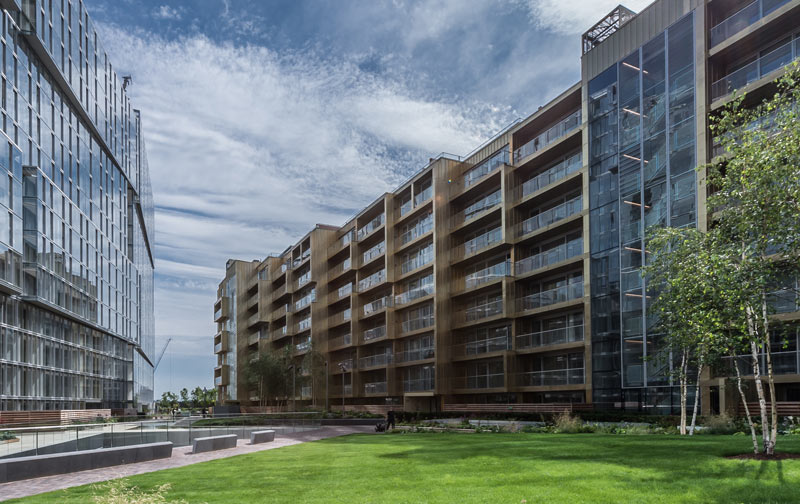
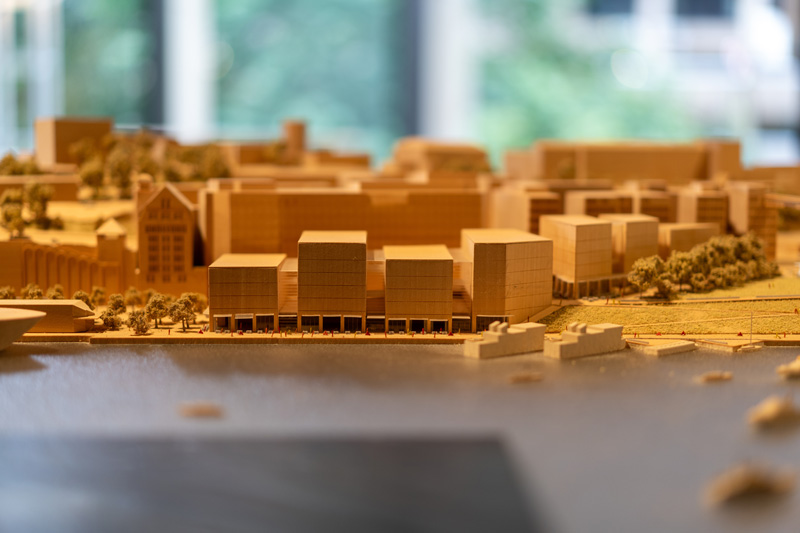
This is exactly what became apparent in a current mixed-use project in Vienna with over 33,000 m² of floor space and a total thermal output of more than 1 MW. Originally, a classic combination of geothermal probe field and heat pumps was planned, supplemented by a large-scale photovoltaic system. Fossil fuels were ruled out, district heating was not available and roof-mounted drycoolers were not an option due to space and funding constraints.
What worked on paper faltered under real conditions.
When the load profile overtakes the planning
The usage parameters changed considerably over the course of the project development. Higher ventilation rates, increasing internal loads and differentiated requirements of individual tenants led to a significant increase in energy requirements – particularly in the area of cooling and ventilation technology.
Simulations showed that the available geothermal probe field was undersized in the long term. A predominant discharge in heating mode would have led to thermal degeneration of the ground, resulting in falling source temperatures – with correspondingly reduced seasonal performance factors for the heat pumps. The typical reaction in such cases is well known: more probes or additional drycoolers. But neither was a realistic option here.
At this point, APESS GmbH was involved in the planning.
A change of perspective: the earth is not an infinite energy store
The decisive paradigm shift was to view the geothermal probe field not exclusively as a heat source, but as a seasonal energy storage system with active management.
Instead of extracting energy from the ground all year round, a balance-oriented charging and discharging concept was developed. Excess heat from cooling processes, from the exhaust air from the ventilation systems and from internal waste heat flows is fed back into the ground in a targeted manner. The probe field is thus regenerated and thermally stabilized in summer.
The result: not a static geothermal system, but a dynamically managed seasonal storage tank with controlled temperature management. Simulations formed the basis for the dimensioning and optimization of the number of probes – with significant effects on the investment costs.
Multivalent heat pump architecture
The concept was technically implemented with large heat pumps that have two evaporators and two condensers and can therefore integrate several energy sources in parallel. This architecture makes it possible to operate different temperature levels simultaneously and to realize internal energy shifts – in other words, to provide heat where it is needed while cooling takes place elsewhere.
The heat is delivered via low-temperature systems, including concrete core activation. This keeps the required flow temperatures low, which has a direct positive effect on the performance figures.
With a total thermal output of over 1 MW, the system operates completely without gas, oil or district heating – while at the same time achieving a high annual coefficient of performance.
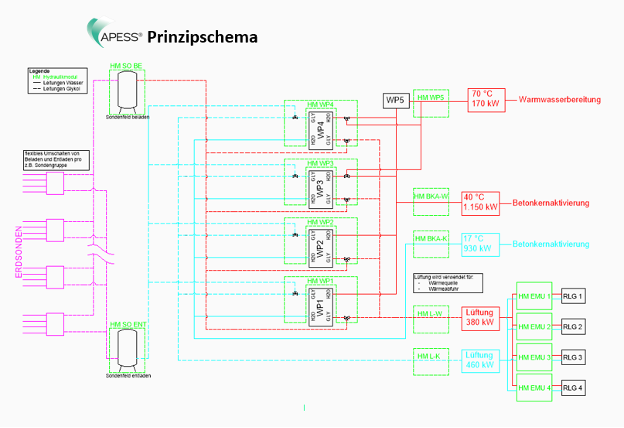
Scheme of the energy center: sustainable and economical
The actual innovation core: the regulation
As sophisticated as the hardware is, the decisive added value lies in the higher-level system control. Instead of optimizing individual components in isolation, the entire system is managed in a balanced manner. Outdoor temperatures, probe temperatures, ventilation conditions, internal loads and photovoltaic yields are continuously recorded and processed in a central control logic.
The aim is not maximum efficiency at one operating point, but year-round optimization across the entire temperature spectrum.
This shifts the focus from pure device performance to system intelligence.
A model for the next generation of urban energy centers?
The project is an example of how monovalent geothermal concepts can quickly reach their systemic limits in complex building structures. It is not only the choice of renewable energy sources that is decisive, but also their intelligent coupling, balance sheet management and control technology integration.
The future of large, fossil-free buildings lies less in ever larger probe fields or more powerful individual machines – and more in integrated, simulation-supported complete systems, such as those that have been successfully managed in the APESS GmbH portfolio for many years.
Do you have questions?

